India's Silver Problem: Reading the 2026 Asian Games Medal Tally
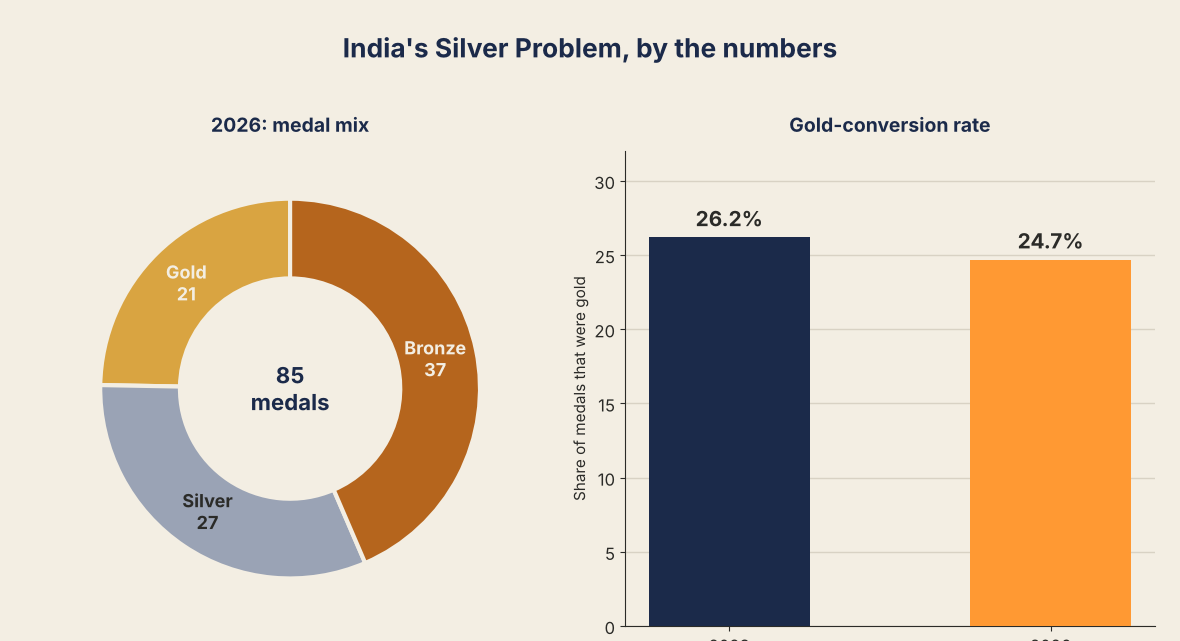
India finished the 2026 Asian Games in Aichi-Nagoya with 85 medals — 21 gold, 27 silver, 37 bronze — good for 4th place overall. On its own, that's a strong number. But it falls short of the record India set at Hangzhou in 2023: 107 medals, including 28 gold.
The gap is more interesting than it first looks, because India sent 503 athletes to Nagoya — one of its largest-ever Asian Games contingents. A bigger team, a smaller haul. The medal tally explains why.
The real story is in the silvers
India won 27 silver medals in 2026 — the single largest share of its medal tally. Every silver means the same thing: an athlete reached the final and lost it.
Look at the ratio instead of the raw count, and the pattern is clearer. Only 24.7% of India's medals in 2026 were gold. In Hangzhou 2023, that number was 26.2%. The difference is small, but it points the same direction: India is reaching finals at a similar rate to before, but converting fewer of them into golds.
Where India overperformed
Some sports delivered exactly what a bigger, better-funded contingent should. Archery won 5 gold medals — its best-ever Asian Games showing. Boxing added 3 golds. Women's team sports had a standout Games: cricket, hockey, and kabaddi all won gold, with the hockey team's win ending a 44-year wait for the title.
Where India fell short
Other sports didn't convert their investment into results. Tennis won zero medals — India's first blank in the sport since 1986. Badminton, despite years of heavy investment following its recent global successes, managed just one bronze. Athletics — the single largest contingent India sent — won only 1 gold, down from 6 at Hangzhou. Rowing had its worst showing in 24 years.
What it means
A medal count alone says India had a good Games. The gold-conversion rate says something more specific: the depth of competitors reaching finals is there, but the final step — closing out the biggest matches — is where India is still losing ground compared to its own benchmark four years ago.
That's a more useful number to track going into Los Angeles 2028 than the medal count by itself.