GST Hit ₹2.04 Lakh Crore in September. Imports Did the Heavy Lifting.
India's gross GST collection for September 2026 was ₹2,03,521 crore — about ₹2.04 lakh crore — up 14.7% from ₹1,77,365 crore a year earlier. It is the kind of headline that gets read as a sign of a booming domestic economy. The breakdown tells a more complicated story.
The split: domestic versus imports
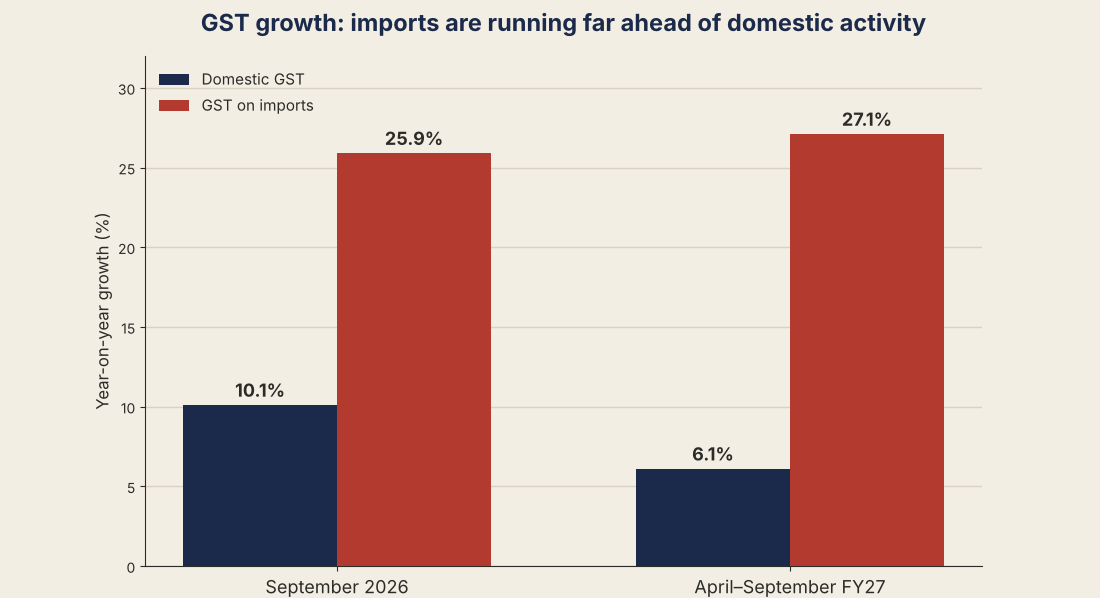
GST collected on domestic activity was ₹1,37,996 crore, up 10.1% from ₹1,25,334 crore. GST collected on imports was ₹65,525 crore, up 25.9% from ₹52,031 crore. Imports grew at more than double the pace of domestic activity.
It is not just one month
The gap widens over the first half of the financial year. From April to September, gross GST collections were ₹12.46 lakh crore, up 11.6%. Domestic GST grew just 6.1% to ₹8.74 lakh crore, while import GST grew 27.1% to ₹3.72 lakh crore.
Imports make up about 30% of the half-year total, yet they account for roughly 61% of the increase, according to The Federal's analysis. In other words, most of the growth in GST collections this year has come from goods crossing the border, not from sales inside it.
Net of refunds
Refunds in September were ₹27,001 crore, down 3%. Domestic refunds fell 13.5% to ₹13,504 crore, while export-related refunds rose 10.2% to ₹13,497 crore. After refunds, net GST revenue was about ₹1.77 lakh crore, up 18.1% — faster than the 14.7% gross growth, because refunds shrank while collections rose.
Is this good news?
It depends on why imports are costing more, and the data does not say. The Federal notes that GST figures alone cannot show what share of imports are raw materials, capital goods or finished products. Possible explanations include higher energy prices, geopolitical disruptions and higher landed costs for commodities, but none of these is quantified in the release.
The two readings point in opposite directions:
- The optimistic reading: businesses are importing raw materials and machinery to meet strong demand, and GST paid on imported inputs can generally be claimed back as input tax credit.
- The cautious reading: imports are getting more expensive in rupee terms, which raises the GST collected without any increase in activity, and adds pressure on the trade balance.
There is also a dissenting view on the headline itself. The Federal reports that Subhash Garg calculated growth of only 2.92% using central GST receipts (CGST, IGST and cess), a narrower measure than the gross figure. The 14.7% is the official gross number, but it is not the only way to measure the tax.
What to watch next
Three things will show which reading is right: whether domestic GST growth picks up from 6.1% as the festive season feeds through, whether import GST growth stays near 26–27%, and what the monthly trade data shows about the size of the import bill. Until then, the ₹2.04 lakh crore headline is accurate, but the more useful number is the gap between 25.9% and 10.1%.