UPI Isn't Slowing. The Merchant Fee Is the Real Test.
The short answer. Has the merchant fee changed how Indians use UPI? Not yet, because it has not started. It applies from 15 October 2026, so every number published so far was set under zero charges. September is the baseline. My expectation is that usage holds, that the strain shows up in value rather than volume, and that the ₹2,000 line is where to look first.
September: a dip with an asterisk
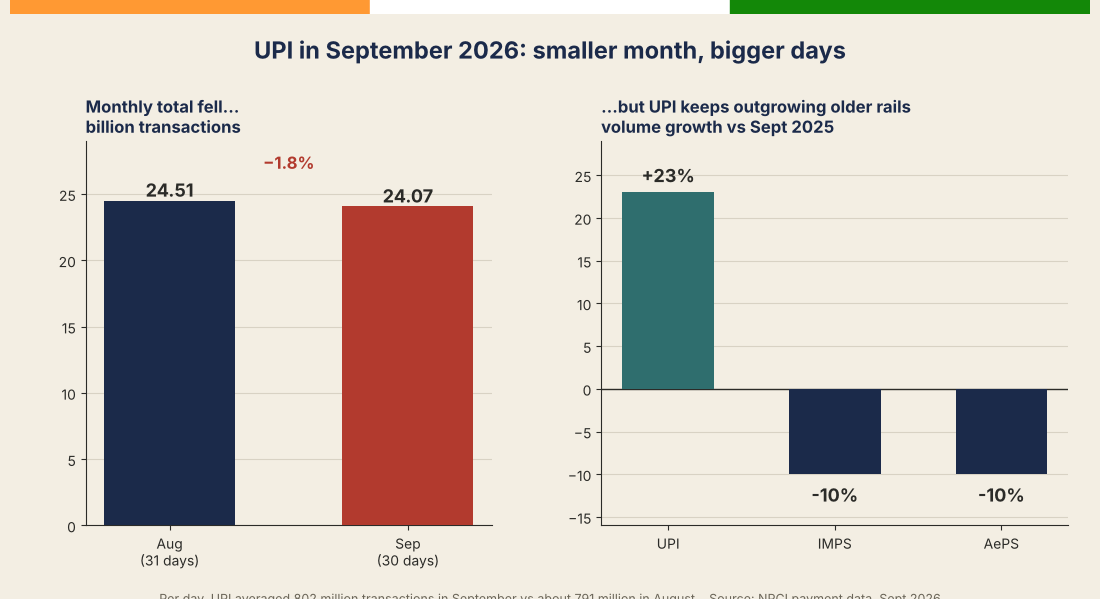
UPI processed 24.07 billion transactions worth ₹29.37 lakh crore in September 2026.1, 2 That is 1.8% fewer transactions than August's record of 24.51 billion, and 1.5% less value than August's ₹29.82 lakh crore.1, 2 Read quickly, it looks like UPI is slowing. It is not.
August has 31 days and September has 30. Divide each month by its days and the picture flips. September averaged about 802 million transactions a day, the first time UPI has crossed 800 million, against about 791 million in August, a gain of roughly 1.5%.1, 3 By value, the daily average rose from about ₹96,200 crore to about ₹97,900 crore, up roughly 1.8%. The per-day figures are our own arithmetic on the reported monthly totals. One of the reports we used notes the day-count effect; another reports the fall without a reason.1, 2
Over the year the trend is strong: volume is up 23% and value up 18% on September 2025.1, 2, 3 The gap between those two numbers matters. It means the average payment is shrinking, from roughly ₹1,270 to roughly ₹1,220 (our estimate, built from rounded growth rates, so treat it as approximate). Older rails are moving the other way: IMPS volume fell 10% and AePS volume fell 10% over the year.2
What changes on 15 October
NPCI will levy a merchant discount rate (MDR) of 0.4% on UPI payments to merchants above ₹2,000, capped at ₹300 a transaction.4, 5 A ₹3,000 payment carries a ₹12 fee, a ₹50,000 payment ₹200, and anything from ₹75,000 up is capped at ₹300.5, 7 NPCI says GST of 18% applies to the fee, not to the payment, which takes the effective rate to about 0.47% (our calculation).6
The design is deliberately narrow:
- Consumers pay nothing. Merchants bear the fee and cannot recover it separately from customers. Person-to-person transfers stay free.5, 7
- Most volume is untouched. NPCI says payments up to ₹2,000 are more than 96% of UPI merchant transaction volume.6
- Small merchants are exempt. Those receiving up to ₹1 lakh a month through UPI pay no fee.4, 6
- Some sectors get a flat fee. Railways, telecom, insurance, fuel and utilities pay ₹5 on payments above ₹2,000; capital-market payments pay 0.02%, capped at ₹300.5, 7
Of each ₹100 paid, the 40 paise fee splits 28 paise to the customer's bank, 8 paise to the UPI app and 4 paise to the merchant's bank.7 The money flows mainly to banks, not to the apps people use every day.
The fee is a break from policy since January 2020, when UPI went zero-fee, a decision credited with helping it scale.9 The finance ministry's argument is that subsidies alone will not carry the next phase of expansion.9 The same government also approved ₹1,500 crore in March 2025, for 2024-25, to incentivise small merchants' UPI payments of up to ₹2,000, at 0.15% of value.10 Read together, the policy line is clear: keep small payments free and subsidised, and ask larger ones to contribute.
Why usage should hold
1. The people who decide to tap "pay" are not charged. UPI's growth is driven by consumers and their habits. A fee that sits on the merchant's side of the transaction does not change what the customer sees on the screen, and merchants are barred from passing it on.
2. The exposed slice is small by count. If 96% of merchant payments are at or below ₹2,000, the fee touches about 4% of them. Volume, the headline metric, is the least exposed number.
3. There is no obvious cheaper substitute at the checkout. Cash is slow to reconcile and cards need terminals. A merchant who drops UPI to avoid a fee of about 0.4% gives up the payment method most customers now expect.
4. Habits are sticky. UPI is processing more than 800 million transactions a day. Behaviour at that scale rarely reverses because a fee lands on one side of the market.
Where it could bite
The value side. One analysis of the proposal estimated that payments above ₹2,000 are only about 5% of transactions by count but roughly 65% by value.9 That is an estimate made before the final rules, so use it as a direction rather than a measurement. If it is close, then value, not volume, is where the fee collects its money and where behaviour could shift.
High-ticket retailers. Analysts cited by Mint estimate the fee would cost Nykaa about ₹29.9 crore a year, around 2.6% of FY27 EBITDA, and DMart about 2.1% of EBITDA. Businesses with orders above ₹2,000, such as FirstCry, Lenskart and jewellers, are most exposed, while food delivery and quick commerce, with orders of roughly ₹380 to ₹540, are largely spared.8 The cost is real but modest. The likely responses are not to abandon UPI but to push margin, advertising or platform-fee levers.
The ₹2,000 cliff. A ₹1,999 payment costs the merchant nothing and a ₹2,001 payment costs about ₹8. Any rule with a threshold invites behaviour around it. Analysts quoted by Mint suggest that bill-splitting, instalments and more planned purchases could follow.8 Whether splitting a bill to stay under the line is permitted or will be policed is not something the sources I reviewed address, so I would not assume either way.
The pass-through gray area. Authorities have said the fee cannot be passed on to customers. But one finance outlet advises consumers to check the final bill on large payments, in case a merchant adds a separate payment-related charge.11 The rule exists; how it is enforced is the open question.
What the 2023 precedent can and cannot tell us
In April 2023 NPCI introduced a 1.1% interchange fee on wallet-funded merchant payments above ₹2,000, a close cousin of this one. I could not find a clean public before-and-after analysis of its effect on usage, and the pre-launch commentary I found only speculated. I would treat it as an untested lesson, not evidence for either side. That is itself a reason for caution about anyone offering a confident forecast now.
My read, and what it means for you
Base case: daily volume keeps growing at a double-digit annual pace, value growth continues to trail volume growth, and the average payment keeps drifting down. The downside case: a visible step-down in the daily average after 15 October that festive seasonality cannot explain, or a sharply widening gap between volume growth and value growth. The upside case: nothing visible in the data at all.
The audience-by-audience view, offered as analysis and not as financial advice:
- Consumers: nothing changes at checkout. Look at the final bill on payments above ₹2,000 and do not accept a separate "UPI charge".
- Small merchants: know your numbers. Under ₹1 lakh a month is exempt, but a business that stays above it for three consecutive months moves into the fee bracket, according to one report.7 Plan for that crossing before it happens.
- Larger retailers: model the fee on your actual basket distribution, with GST on it, and decide early whether it comes out of margin, platform fees or advertising. Do not count on being able to pass it on.
- Investors and fintech watchers: the apps keep only a sliver of the fee, so the first-order gain goes to banks. The second-order story is whether value growth slows for merchants with big baskets.
- Policy watchers: the real test of the design is the near-zero-cost small-payment zone staying as popular as it is today.
The scorecard: what to watch and when
| Indicator | September baseline | Why it matters |
|---|---|---|
| Daily average transactions | ~802 million | Falls below the baseline after 15 Oct, beyond festive effects, would be the first warning |
| Volume growth vs value growth (YoY) | +23% vs +18% | A wider gap suggests shrinking ticket sizes or a shift in value |
| Average payment | ~₹1,220 (estimate) | Watch for more payments clustering just under ₹2,000 |
| Large-retailer commentary | n/a | Earnings calls on basket sizes and fee absorption |
Timing matters. NPCI's October data, usually published in the first days of November, will cover only about two weeks of the fee, mixed with festive demand. November's figures, due in early December, will be the first full month. Compare year on year, not month on month, because festivals distort the monthly sequence.
The bottom line
September's dip is a calendar effect, and the daily record is the real signal. The fee does not change a consumer's decision to pay with UPI, and 96% of merchant volume is untouched. What it changes is the economics of larger payments. The honest forecast is that volume holds and the pressure shows up in value and in a few high-ticket businesses, but the first real evidence arrives only after 15 October. Until then, September is the baseline to measure it against.
Notes: Figures are as reported in early October 2026 and may be revised. Daily averages, the average payment size and the effective rate with GST are our calculations. Sources differ on whether a payment of exactly ₹2,000 attracts the fee; most describe the fee as applying "above ₹2,000". The fee had not taken effect when this was written (7 October 2026), so no usage impact can be measured yet. This is analysis, not investment or financial advice.
Sources
- Startuptalky: UPI Daily Transactions Cross 800 Million for the First Time — 24.07 Billion Transactions in September 2026
- FintechBizNews: UPI TXN Volume & Value Fell In Sept '26 — AePS & IMPS Volumes Also Drop
- Chronicle India: UPI transactions surge 23% to 24.07 billion in September
- The Indian Eye: UPI charges to apply on large merchant payments from October 15
- Swarajya: UPI MDR from October 15 — NPCI sets 0.4 per cent merchant fee on payments above Rs 2,000, caps charge at Rs 300
- Business Today: UPI MDR GST — NPCI says small merchants and 96% of transactions remain unaffected from October 15
- Inc42: UPI MDR Regime Explained — Here's What Will Be Charged After Oct 15
- Mint/HT Digital (via TradingView): UPI MDR to pinch retailers with bigger baskets, while sparing others
- Payment Expert: UPI — add fees to support sustainability
- Deccan Herald: Union Cabinet approves Rs 1,500 crore to incentivise low-value UPI transactions
- Outlook Money: UPI MDR above Rs 2,000 — why consumers need to check their final bill